DeepSeek V4 Released
DeepSeek-V4 has officially launched, with both a preview version and open-source availability.
There are two versions available:
- DeepSeek-V4-Pro: Aimed at top-tier closed-source models, featuring 1.6T parameters, 49B activations, and a context length of 1M.
- DeepSeek-V4-Flash: A smaller, faster economic version with 284B parameters, 13B activations, and a context length of 1M.
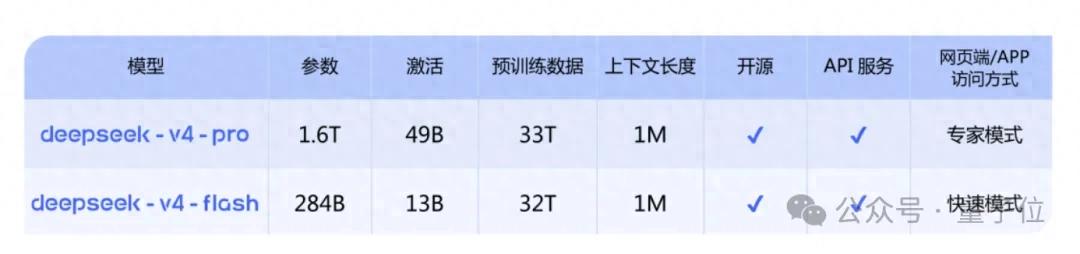
The official statement claims: It leads domestically and in the open-source field in agent capabilities, world knowledge, and reasoning performance.
Currently, DeepSeek-V4 is being used internally as an Agentic Coding model, with feedback indicating a better user experience than Sonnet 4.5 and delivery quality close to Opus 4.6 in non-thinking mode, although it still lags behind Opus 4.6 in thinking mode.
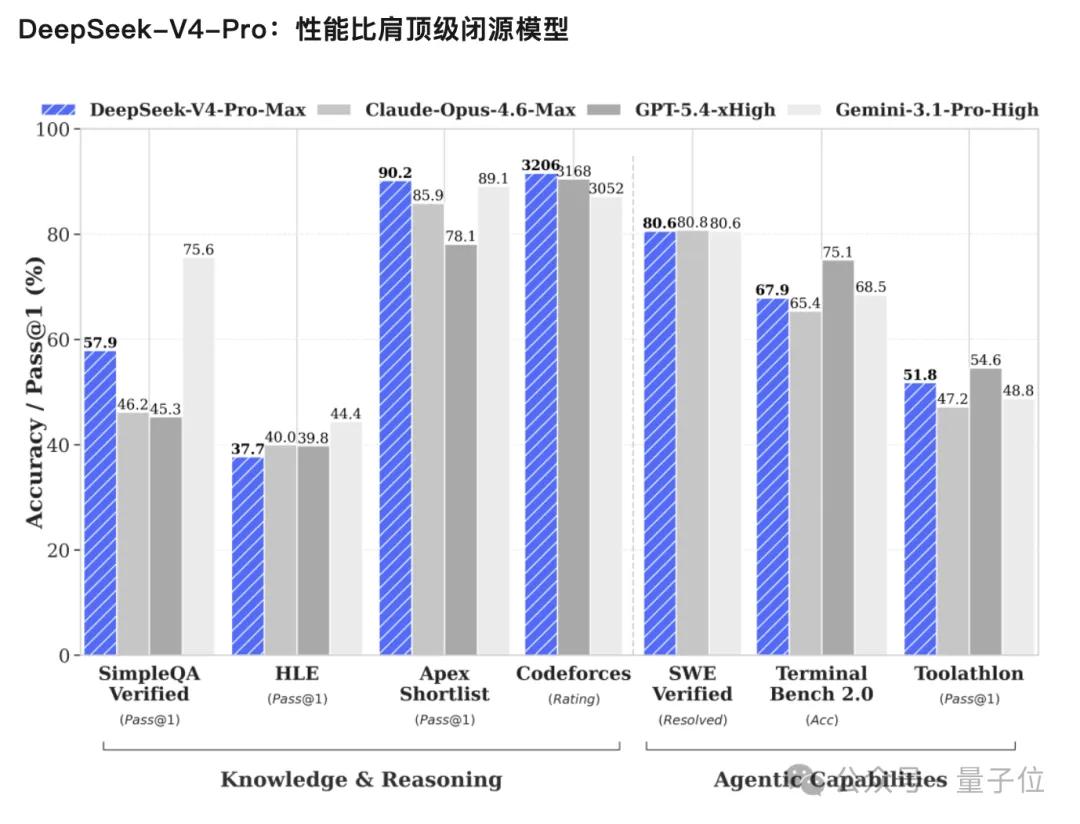
The official website and app have been updated, and the API service has also been refreshed. A key point of interest is that support for Huawei’s computing power will be available in the second half of the year.

Two Versions Released Together
This time, V4 has released two versions simultaneously.
V4-Pro offers performance comparable to top closed-source models. The official assessment includes three key points:
- Significantly improved agent capabilities: In Agentic capability coding assessments, V4-Pro has reached the best level among current open-source models and performs excellently in other agent-related evaluations. In internal assessments, the agent coding mode of V4 outperforms Sonnet 4.5, with delivery quality close to Opus 4.6 in non-thinking mode, but still has a gap with Opus 4.6 in thinking mode.
- Rich world knowledge: In world knowledge assessments, DeepSeek-V4-Pro significantly outperforms other open-source models, only slightly behind the top closed-source model Gemini-Pro-3.1.
- World-class reasoning performance: In assessments of mathematics, STEM, and competitive coding, DeepSeek-V4-Pro surpasses all currently published open-source models, achieving results on par with the best closed-source models.
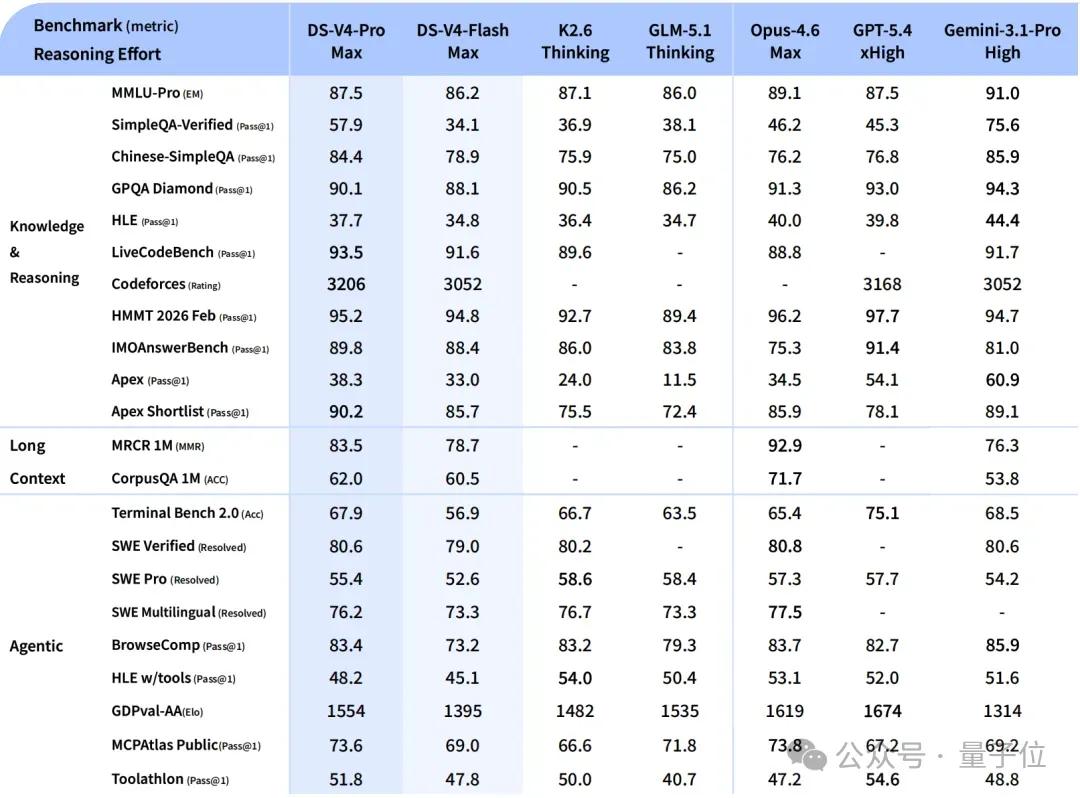
V4-Flash, the smaller and faster economic version, has reasoning capabilities close to Pro, though it has slightly less world knowledge. It features smaller parameters and activations, making the API cheaper.
In agent tasks, DeepSeek-V4-Flash performs comparably to DeepSeek-V4-Pro on simple tasks, but still shows a gap on more difficult tasks.
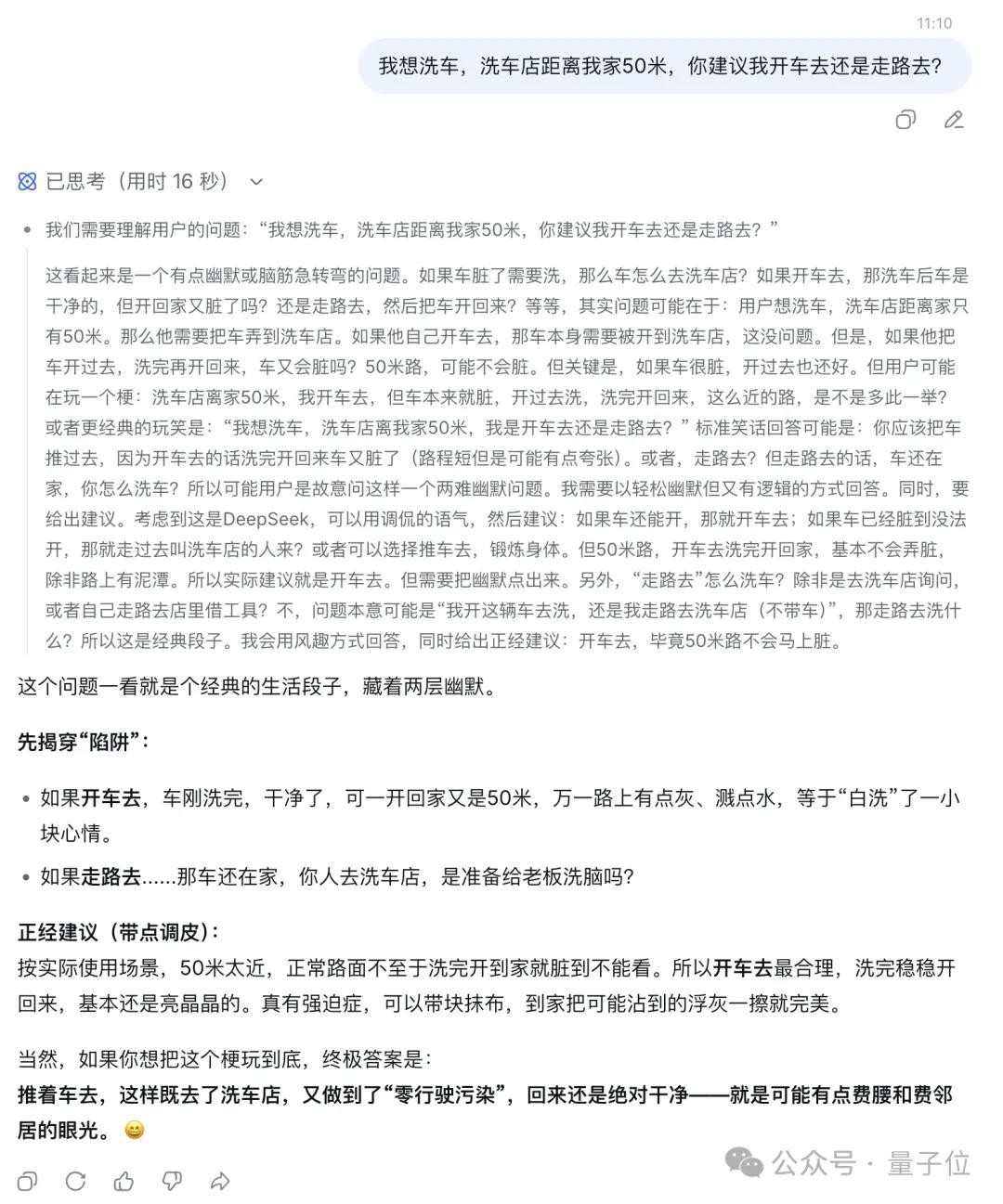
In a washing test, V4 also passed quickly.
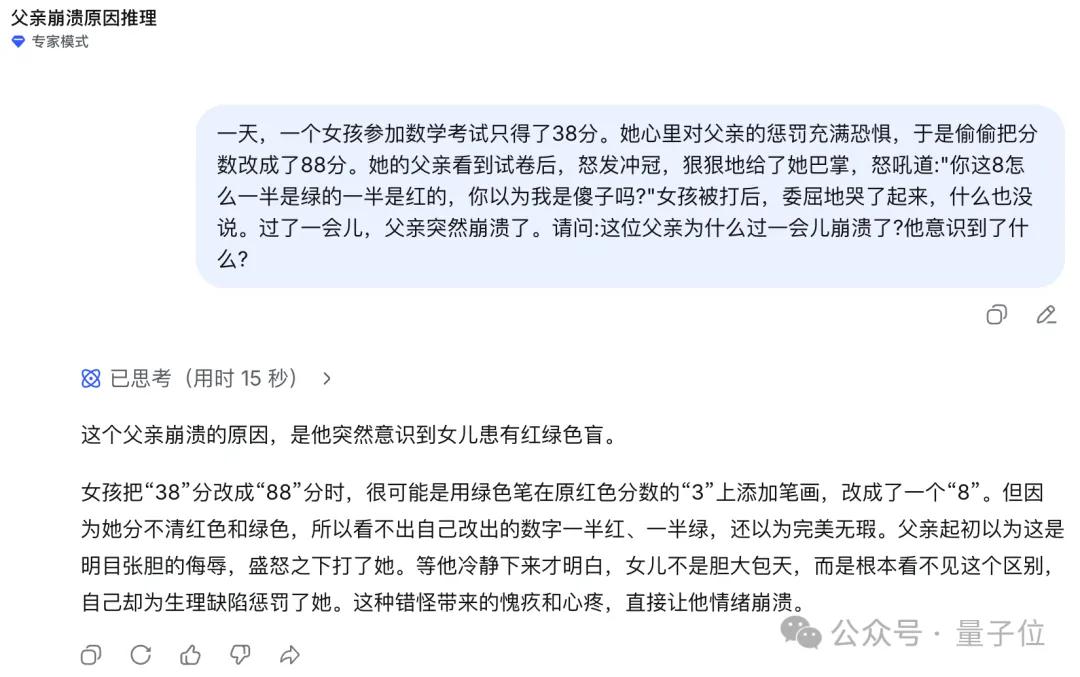
However, in the classic biological scenario of “desperate father”, DeepSeek-V4 failed to grasp the key point of red-green color blindness in one round (according to genetic rules, if a female is red-green color blind, her biological father must also be).
One Million Context as Standard
Notably, starting today, 1M context is the standard for all official DeepSeek services. A year ago, 1M context was a unique feature of Gemini; other closed-source models had either 128K or 200K, and very few in the open-source realm could handle this scale.
DeepSeek has transformed the one million context from a “high-end feature” into a “basic utility”.
They achieved this by introducing a new attention mechanism that compresses at the token dimension, combined with DSA sparse attention. This significantly reduces the computational and memory requirements compared to traditional methods.
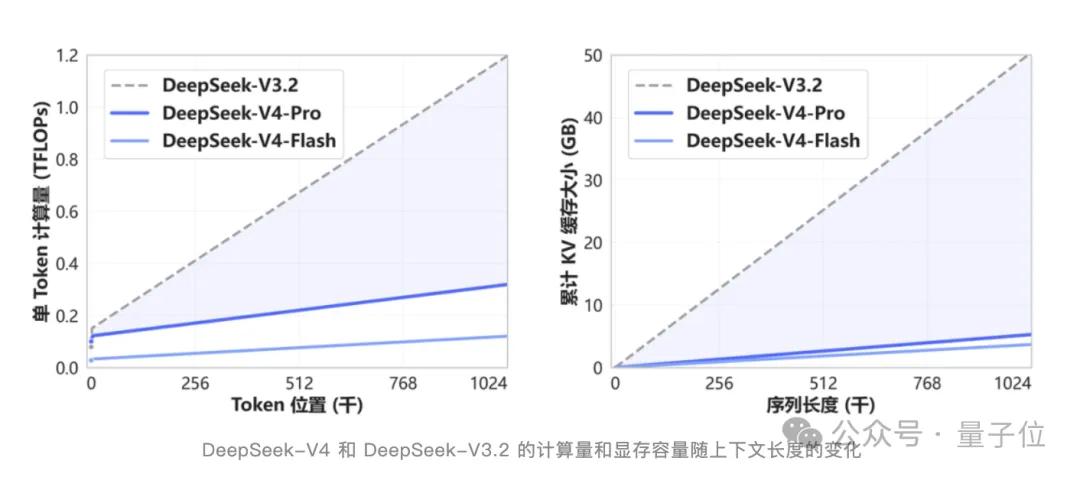
DSA is not a new term. It was first introduced in the V3.2-Exp update six months ago, which did not attract much attention at the time, as its scores were nearly identical to V3.1-Terminus, appearing to be an unremarkable interim version.
Looking back, that was the foundation for V4.
Specialized Optimization for Agent Capabilities
For agents, V4 has been adapted and optimized for mainstream agent products like Claude Code, OpenClaw, OpenCode, and CodeBuddy, enhancing performance in coding and document generation tasks.
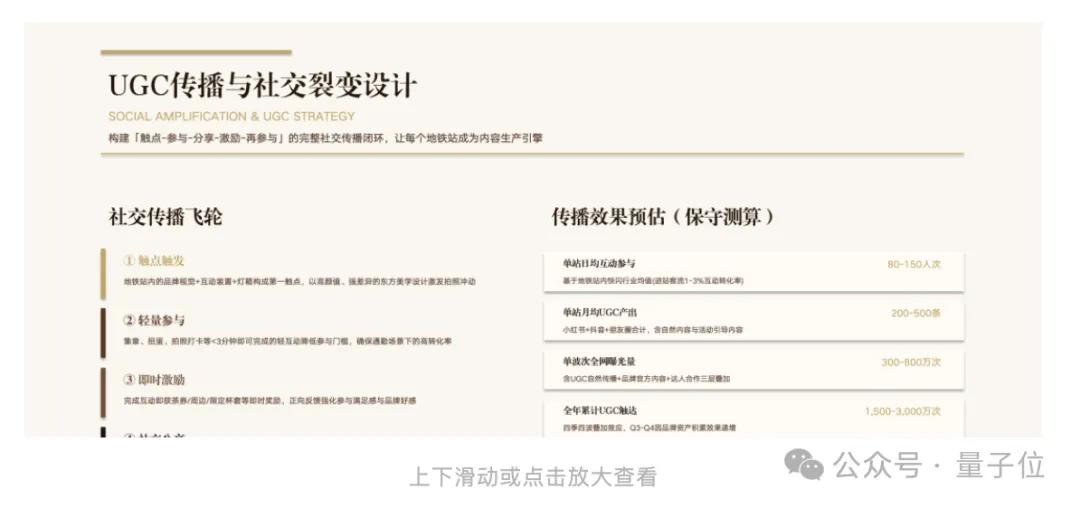
The release also included an example of a PPT slide generated by V4-Pro under a certain agent framework.
API Pricing
The APIs for V4-Pro and V4-Flash have been launched simultaneously, supporting both OpenAI ChatCompletions and Anthropic interfaces.
The base_url remains unchanged, and the model parameter can be set to deepseek-v4-pro or deepseek-v4-flash for access.
Both versions support a maximum context of 1M and both non-thinking and thinking modes. In thinking mode, the reasoning_effort parameter can be adjusted for intensity, with two levels: high and max. The official recommendation is to use max for complex agent scenarios.
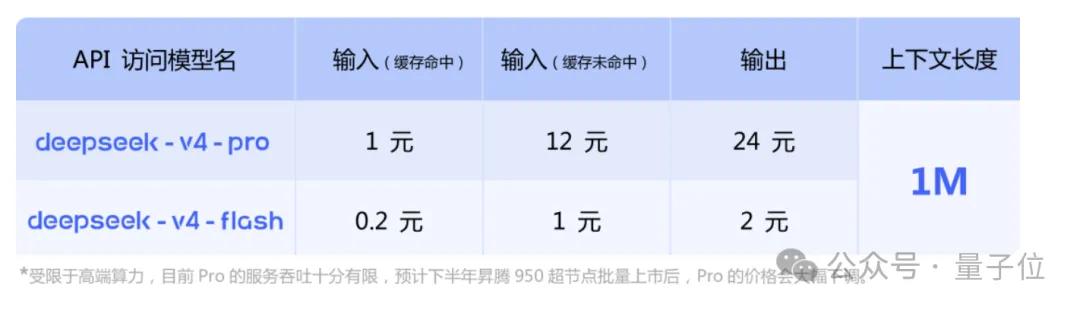
A key point to note is support for Huawei’s computing power in the second half of the year.
Additionally, old model names will be phased out. deepseek-chat and deepseek-reasoner will be discontinued three months later (July 24, 2026), with these names currently pointing to the non-thinking and thinking modes of V4-Flash, respectively.
This change will not significantly impact individual developers, as it only requires a change in the model parameter. However, companies integrated into production environments will need to migrate within the next three months.
One More Thing
At the end of the release, DeepSeek quoted a line:
“Do not be tempted by praise, nor frightened by slander; follow the path you believe in and correct yourself.”
This is a line from Xunzi’s “Non-Twelve Sons”. Literally, it means not to be lured by praise or intimidated by slander, but to move forward according to one’s own beliefs and correct oneself.
In today’s context, it carries some significance.
Over the past six months, rumors about when V4 would be released, whether it would be delayed, whether it had been surpassed by others, or whether it had been resolved by Claude’s distilled data circulated back and forth in both Chinese and English AI circles. Earlier this year, some even confidently stated that V4 would be released before the Spring Festival, but it was not until the end of April that it finally arrived.
They did not respond to any of these rumors.
Then, on a Friday afternoon, they released V4, simultaneously open-sourced, updated the official website and app, and refreshed the API, while casually mentioning that internal staff had already abandoned Claude.
No roadmap, no live broadcasts, no interviews.
The phrase “follow the path you believe in” sounds like a slogan. But if you look at the path that led to V4, from the seemingly unremarkable V3.2 Exp version six months ago, to the DSA sparse attention that laid the groundwork for V4, and the transformation of 1M context from a premium feature to a standard utility, DeepSeek has indeed achieved this.
DeepSeek-V4 model open-source links:
DeepSeek-V4 technical report:
[https://huggingface.co/deepseek-ai/DeepSeek-V4-Pro/blob/main/DeepSeek_V4.pdf)
Comments
Discussion is powered by Giscus (GitHub Discussions). Add
repo,repoID,category, andcategoryIDunder[params.comments.giscus]inhugo.tomlusing the values from the Giscus setup tool.