Introduction
AI programming is no longer about whether it can be used, but rather about which one fits your workflow best.
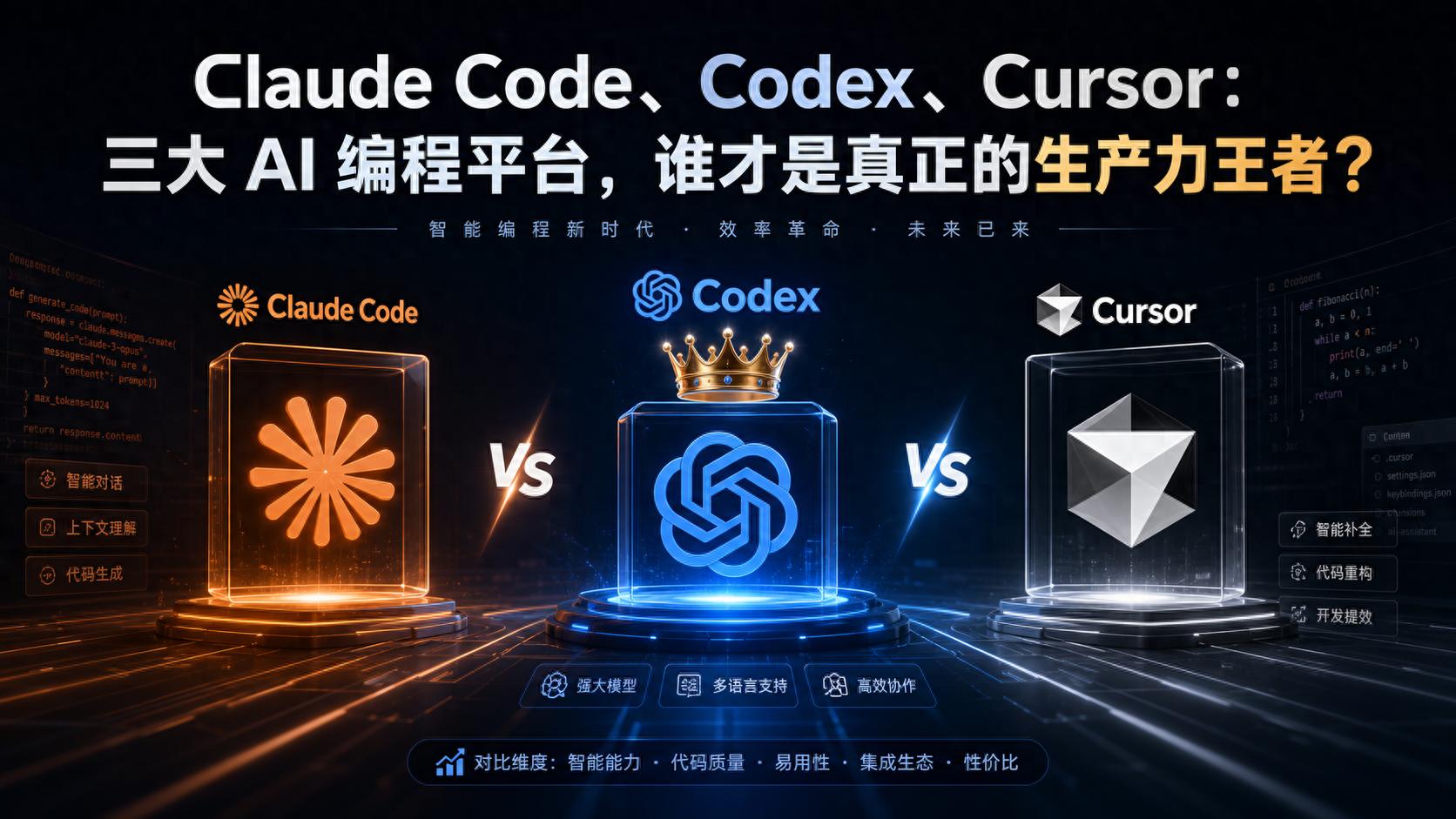
The three mainstream agent development platforms worth focusing on are Claude Code, Codex, and Cursor. They are all evolving towards allowing AI to directly participate in development, but they take completely different approaches:
- Claude Code is more like “autonomous driving in the terminal”
- Codex resembles “an AI engineering platform within the team”
- Cursor acts like “the co-pilot in your editor”
If you are a developer, technical leader, or involved in AI application implementation, the differences among these three will determine whether you improve efficiency by 30% or completely restructure your development process.
Conclusion: They Complement Different Scenarios
Many people ask: Which is stronger, Claude Code, Codex, or Cursor?
The answer is not about who is absolutely the strongest, but rather who is more suitable for your task type.
1. Claude Code: Suitable for Complex, Long-Chain, and Automated Tasks
The core value of Claude Code is transforming Claude into a truly autonomous coding environment. Anthropic’s official best practices repeatedly emphasize its ability to read files, run commands, modify code, and perform validations, making it suitable for:
- Exploring, planning, and coding sequentially
- Self-validation through tests, screenshots, and output results
- Parallel processing of multiple sessions
- Running automated tasks through non-interactive mode
- Utilizing subagents for investigation, review, and diversion
- Reducing permission prompts through sandboxing to enhance autonomy
In summary, the keywords for Claude Code are: stable, deep, long, and controllable.
2. Codex: Suitable for Team Collaboration, Cloud Execution, and SDK Integration
Codex is positioned more as a “platform.” In the GA version, OpenAI emphasized several keywords:
- Slack integration
- Codex SDK
- Cloud tasks
- Administrator console
- Usage analytics and security governance
Its advantage lies not merely in writing code but in integrating agents into team processes. You can @Codex in Slack to grab context, select environments, handle tasks, and return results via links. It functions more like an AI engineering collaboration system for organizations.
3. Cursor: Suitable for Daily Coding, In-Editor Looping, and Quick Onboarding
Cursor’s advantages are straightforward: it integrates agents, code editing, terminals, planning, subagents, skills, and hooks directly into the editor. According to Cursor’s official documentation, agents can independently complete complex coding tasks, run terminal commands, and edit code; the new version has strengthened multi-agent interfaces, plan modes, subagents, skills, and hooks.
The keywords for Cursor are: handy, fast, and low friction.
Comparison of Product Positioning: They Solve Different Problems
Claude Code: Upgrading “Writing Code” to “Delivering Tasks”
Claude Code’s design philosophy is clear: it does not just help you fill in a few lines of code but assists you in completing an entire engineering task.
Anthropic’s best practices emphasize three key points:
- Explore before coding to avoid heading in the wrong direction from the start.
- Validation is essential, relying on tests, screenshots, and output results for closure.
- Context control is necessary, using clear instructions, CLAUDE.md, hooks, and subagents to manage complexity.
This makes it particularly suitable for:
- Large repository refactoring
- Multi-file linked modifications
- CI/scripts/automated fixes
- Long-running tasks
- Engineering scenarios requiring high reliability
If you are looking to assign a real engineering task to AI, Claude Code is the most “work-oriented agent” among the three.
Codex: Upgrading “AI Coding” to “Engineering Organizational Capability”
Codex’s focus is not on the editor but on organized collaboration.
OpenAI has developed Codex into a complete system: CLI, cloud tasks, Slack, SDK, and management consoles are all interconnected. It allows teams to embed agents into real engineering workflows, such as:
- Assigning tasks in Slack
- Completing development tasks in the cloud
- Integrating SDKs with proprietary toolchains
- Managing permissions, environments, and audits through an admin panel
Thus, Codex is more suitable for:
- Team collaborative development
- Automated code reviews
- CI/CD integration
- Enterprise-level management
- Systematic engineering implementation
If Claude Code leans towards individual autonomy, Codex resembles “organizational AI infrastructure.”
Cursor: Upgrading “AI-Assisted Coding” to “Native Collaboration in the Editor”
Cursor’s strongest aspect is its integration of agents into the developer’s most familiar environment.
According to Cursor’s official documentation, agents can independently complete complex tasks, adjust terminals, modify code, and continuously track context; Cursor 2.0 has further enhanced capabilities like Composer, multi-agent interfaces, plan modes, subagents, skills, and hooks.
This makes Cursor well-suited for:
- Daily coding
- Rapid iteration
- Local feature development
- Requirement breakdown and planning advancement
- A development approach that allows for “writing, questioning, and modifying simultaneously”
The essence of Cursor is making AI a part of the IDE. For many engineers, this experience feels the most natural.
Capability Comparison: Look Beyond “Who Can Write Code” to “Who Can Execute the Workflow”
1. Context and Task Length
- Claude Code: Strong in managing long contexts and complex tasks, suitable for continuous progress.
- Codex: Strong in task flow across environments, teams, and terminals.
- Cursor: Strong in continuous collaboration within the editor, providing the smoothest experience.
2. Degree of Automation
- Claude Code: Very strong automation capabilities, especially suitable for non-interactive, parallel sessions, and auto mode.
- Codex: Automation capabilities are more organization-level and cloud-based.
- Cursor: Automation is sufficient but leans more towards “human-machine co-writing” rather than complete detachment.
3. Team Collaboration
- Claude Code: More like a high-level personal tool, but can also integrate into team processes.
- Codex: Most resembles a team collaboration platform, especially suitable for Slack/management/control/SDK.
- Cursor: Suitable for high-frequency collaborative development from individuals to small teams.
4. Security and Control
- Claude Code: Emphasizes permission modes, sandboxing, MCP, and hooks, providing a strong sense of security control.
- Codex: Focuses on management and governance, leaning towards enterprise-level control.
- Cursor: Emphasizes modes, usage management, planning, and review, with a stronger experiential aspect.
Real Use Cases: How Should You Choose?
Choose Claude Code if you need:
- An agent capable of independently advancing complex engineering tasks.
- Strong task breakdown and self-validation capabilities.
- A development experience better suited for terminal workflows.
- Higher autonomy and security boundaries.
Choose Codex if you need:
- Team-level AI coding collaboration.
- Integration of Slack/SDK/cloud workflows.
- Administrator control, auditability, and scalability.
- To truly embed agents into enterprise engineering processes.
Choose Cursor if you need:
- The quickest onboarding AI coding experience.
- Direct collaboration with agents in the IDE.
- Enhanced efficiency in daily coding.
- Stronger interactivity and editor closure.
Summary of the Three
- Claude Code: More like “autonomous driving”
- Codex: More like “team platform”
- Cursor: More like “front-row co-pilot”
If you are a heavy developer, these three are not mutually exclusive but can be layered together:
- Cursor handles high-frequency coding.
- Claude Code manages complex tasks and batch automation.
- Codex facilitates team collaboration and organizational integration.
This is the approach that is closer to the future of usage.
Conclusion: The Competition Among AI Programming Platforms Has Shifted
In the past, the competition was about model parameters, response quality, and code completion speed. Now, the real competition has transformed into:
- Who can understand complex codebases
- Who can execute long tasks
- Who can integrate into team processes
- Who can shift humans from “writing code” to “managing tasks”
Therefore, when looking at Claude Code, Codex, and Cursor today, we can no longer view them as ordinary tools.
They are essentially competing for one thing: the future entry point for developers.
Whoever secures this entry point will be closer to the next generation of software production methods.
Comments
Discussion is powered by Giscus (GitHub Discussions). Add
repo,repoID,category, andcategoryIDunder[params.comments.giscus]inhugo.tomlusing the values from the Giscus setup tool.